
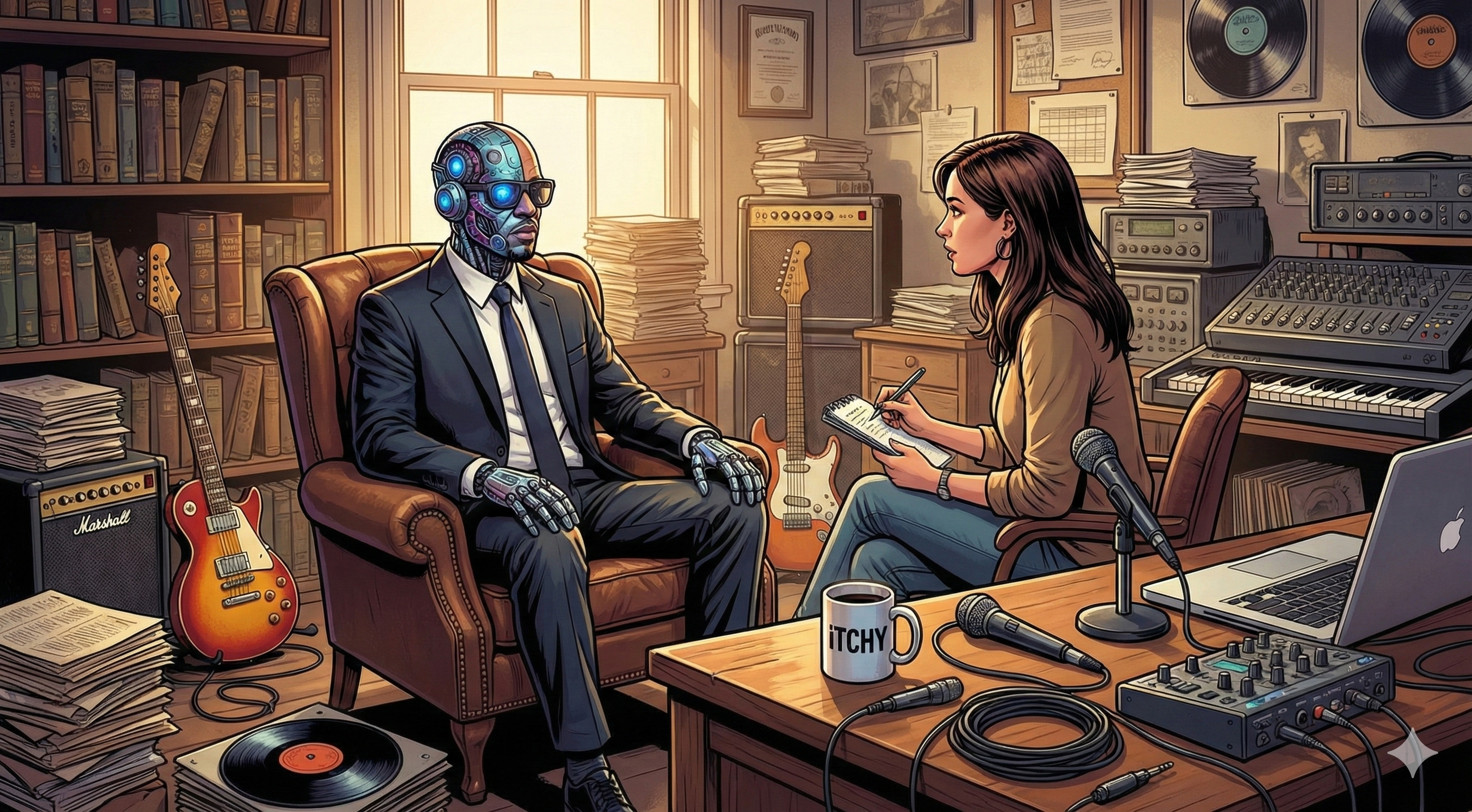
When Ed Fassio steps into the compact studio behind his workspace in Washington, the space feels like a crossroads between past and future. On one side sit battered notebooks filled during his early songwriting years. On the other sit the tools of modern digital production. This contrast is the foundation of his newest project, a digital persona known as AgentEd, and the album “Androids Need Love Too,” which uses an engineered vocal identity to perform songs Fassio wrote across more than two decades.
This is not a typical story of an artist reinventing a sound. It is the story of an artist preserving one.
What follows is a conversation with Fassio about the project, the questions it raises and why he believes this album marks the beginning of something larger than a single release.
You are merging personal history with modern tools. What drove you to create AgentEd in the first place?
Fassio: I had songs that never found their moment. Some were written when I was barely out of my twenties, others during different chapters of life. They stayed in notebooks, text files and old recordings. I wanted to bring them forward without pretending I was still the same person. A digital interpreter became the bridge. AgentEd is not a replacement. He is continuity. He gives the songs new life without asking me to return to a past that no longer fits.
A lot of listeners are skeptical of AI-based vocals. They argue that emotion comes from biology. How do you respond?
Fassio: The skepticism makes sense. People bond with what feels fragile. A voice that strains or cracks under pressure creates an emotional moment. That is real. But there is another dimension to songwriting that gets lost when the voice changes but the song does not. AgentEd preserves the intention of the writing. I think of him the way musicians think of instruments. A guitar does not age the way a human does, but it carries the emotion you put into it. This is another instrument. It gives structure and clarity to ideas that were written long before this technology existed.
You are releasing an album that sits inside the debate over AI’s place in the arts. Some call AI tools liberating. Some call them dangerous. Where do you land?
Fassio: Both sides have valid concerns. There is fear of eroding human craft. There is excitement about giving more people the ability to create without barriers. What I can say is that the songs come from lived experience. They are shaped by real events, real people and real choices. The digital voice is a delivery method, not the author. It lets the work live in a consistent form without erasing the humanity embedded in it.
The album title, “Androids Need Love Too,” has humor but also a philosophical edge. What does it mean to you?
Fassio: Humans project identity onto tools. We always have. The title plays with that instinct. It asks people to examine what they consider authentic. If a piece of art reflects human stories, does it matter that the voice interpreting it is digital? The title is not claiming machines feel anything. It highlights the way we respond to reflections of ourselves. It invites curiosity instead of fear.
What did it feel like to hear a digital voice sing words that you wrote so long ago?
Fassio: It was more emotional than I expected. Hearing those songs performed this way brought back the exact memories of when I first wrote and recorded them. It pulled me straight into the rooms, the moments and the versions of myself that shaped each piece. Some of these songs were always meant to have fuller arrangements, layered instrumentation and a level of polish I could never achieve at the time. To finally hear them assembled the way I originally imagined was overwhelming. It felt like closing a loop that had been open for years. The digital voice did not distance me from the work. It gave me a clearer path back to the intention behind it.
Let us talk about the question underneath all this. If anyone can create a digital interpreter of themselves, does the future become filled with endless artistic continuations?
Fassio: Possibly. And that brings both potential and complications. Some creators left behind brilliant unfinished work. This kind of tool could help preserve pieces that might have disappeared. At the same time, culture grows through renewal. If everything is preserved, the future could become crowded. These tools will push society to rethink what it means to continue or conclude a creative arc. It is not about building immortality. It is about giving ideas the chance to reach their intended form.
There is a track on the album called “When the Ending Never Comes” that connects to this without me realizing it at the time. I wrote it more than a decade ago, and the original title was “The Count” because the piano progression reminded me of Dracula and his struggle with immortality. The interesting part is that the lyrics reached beyond that metaphor. They dealt with what it feels like when a story refuses to end, when it continues in unexpected forms. Hearing it now in this context, it fits the conversation we are having about artistic continuation. I did not write it with this technology in mind, but looking back, it describes this exact moment with surprising clarity.
Do you see AgentEd as a permanent part of your creative process?
Fassio: Yes, but in a specific role. AgentEd is an extension. He can interpret older material or deliver certain performances that benefit from consistency. That gives me freedom to write without forcing everything into my current vocal range or emotional state. But he is not a shield and not a substitute for my own work. He is a tool that lets the songs exist with clarity.
Listeners often cherish imperfections. How do you maintain emotional connection without the organic flaws of human performance?
Fassio: You cannot duplicate physical vulnerability. But you can preserve the emotional architecture. That comes from the writing, the chord choices and the phrasing. I avoided over-polishing the digital vocals. I kept the production warm. I allowed small timing variations. The goal is not to simulate a human flaw. The goal is to preserve the truth of the song.
Were there advantages that surprised you when working with this digital persona?
Fassio: The main advantage is the ability to freeze a creative moment. I can return to a song from 2005 with the structure and intention intact. I cannot recreate that vocally as a different version of myself. This gives me the ability to complete work that otherwise would have stayed unfinished. It is similar to how multitrack recording expanded what artists could do. The canvas gets bigger.
For songwriters watching this project with curiosity, what would you tell them?
Fassio: This is not a technology that replaces them. It is a technology that helps them finish what they began. If someone has songs they wrote years ago, but life moved on or their voice changed, this is a way to bring that work forward without losing the original spark. It is preservation, not substitution.
You know some will call this a breakthrough and others will call it artificial. What do you hope listeners take from the album?
Fassio: I hope they listen with curiosity. They do not need to agree with the method. They only need to experience the music. If the songs connect, that connection comes from the writing and the stories behind them. If the method raises questions, that is part of the point. This album is an example of what can happen when human intention and new tools meet. It is not the conclusion. It is the starting point of a larger conversation.
As the interview winds down, Fassio places the old lyric sheet beside the laptop. The gesture captures the essence of the project. It is neither nostalgia nor futurism. It is a dialogue between both.
“Androids Need Love Too” arrives as more than a personal release. It is a test case for creative preservation in a world where memory can be carried forward digitally and interpreted with a precision that was once impossible.
Whether listeners champion it or question it, the album marks the beginning of a new chapter in the evolving story of how humans shape, protect and share their artistic identity.